Showing posts with label guest blogger. Show all posts

Thursday, January 21, 2010

Guest Blogger Part Two: Tarantino and Peckinpah, Auteurs of Revenge Violence

The following is part 2 of Monday's post. Here inaugural guest blogger Dell Smith discusses violence in Quentin Tarantino's movies.

Pupil Tarantino tweaks Peckinpahís vision of revenge ethics so that dilemmas are never black and white. Tarantinoís rogue characters operate in a contemporized moral gray area. In his first movie, Reservoir Dogs, a band of robbers is hired by a third party to pull a heist.


After the robbery, the band meets in an abandoned L.A. warehouse where each character introduces personal codes that fuel his behavior. For example, Michael Madsonís Mr. Blonde likes to torture cops, and Harvey Keitelís Mr. White is an old-school criminal in it for the money. Mr. White also has a gooey moral center that does him in by the end when he discovers the robber heís been protecting turns out to be an undercover cop.


In Pulp Fiction's moral universe, Butch the fighter (Bruce Willis), through a series of random events, helps his nemesis, Marsellus Wallace (Ving Rhames), out of a tight spot. Butch and Marsellus are tied together by double-cross and revenge: Butch was paid to throw a fight which he did not. Marsellus lost big money and wants Butch gone. Saving Marsellusí from the clutches of a couple of L.A. racists will more than square Butch. Butch is generally honorable, so watching him liberate Marsellus is entertaining and satisfying.


In Kill Bill 1 and 2, Tarantino serves revenge as the main course, and turns in over three hours of Uma Thurman's wronged Bride as an ass-kicking samurai warrioress bent on completing the titular task. Itís almost a let down when Bill is finally killed with a low-key martial arts blowótame compared to the mayhem that precedes it.

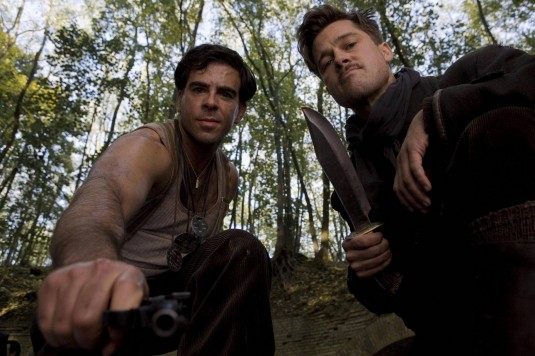
With Inglourious Basterds, Tarantino revises WWII for a new generation, this time as a revenge-fueled fantasy pitting American and French Jews against Nazis in German-occupied France. Audiences gave two thumbs up to the movieís hard R-rated violence, perhaps suggesting Americans are collectively tired of fighting unwinnable wars and amorphous foes. Maybe we want to relive Americaís last genuine win.


The opening scene of Inglourious Basterds extends for about 20 minutes. Presented in real-time, the scene sets up many things: weíre in Nazi-occupied France and are in the company of feared Nazi Colonel Hans Landa, nicknamed the Jew Hunter. During an extended dialogue scene in a farmhouse where he sweats a farmer for information, Landa determines that the cellar below them is the hiding place of a Jewish family. When German soldiers kill the family, a girl escapes.

This sets up what must be the most outrageous revenge fantasy ever filmed. Tarantino revises history to suit his purposes of conflict, tension, and revenge. Seeing a theater-full of Nazis, including Hitler, Goering, and Goebbels, die at the end of the movie was a little bit of heaven on a rainy September afternoon. For decades the Holocaust has been the subject of movies that were sometimes of questionable taste. Finally a filmmaker cuts to the chase and shows us what audiences have wanted all along.


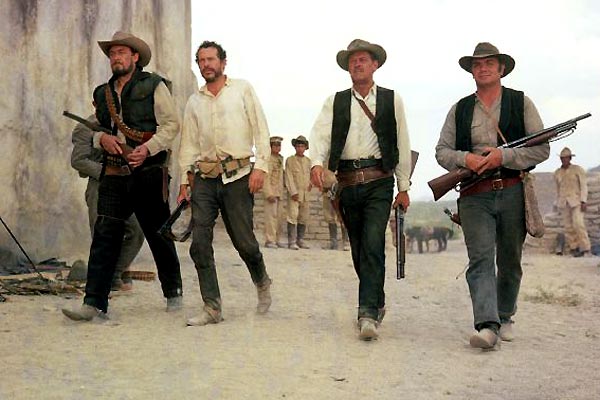
Where does violence in movies go from here? What else is there for these aging outsider anti-heroes and their directors to do? Peckinpah, for his part, tackled oncoming old age by asking the macho old-man question: how do you grow old without getting done in by modern ways? The essence of Peckinpahís aging moral outrage can be reduced to a moment, a sentence, when during The Wild Bunchís opening bank robbery William Holden shouts to one of his Bunch: ìIf they move, kill ëem.î

Tarantino, now in his mid-to-late 40s, shows no sign of changing gears. As he said in the August 2009 GQ, he has already made his character-driven, mature work about getting old, Jackie Brown. ìAnd itís as much of an old-man movie as I ever want to make.î Tarantino will eventually pass the torch to another generation of revenge-violence filmmakers, but it sounds like heís not going quietly out without a cinematic fight.

The opening bank robbery from The Wild Bunch:


Need more? To see an 30-second distillation of Reservoir Dogs performed by animated bunnies, click here.

Monday, January 18, 2010

Guest Blogger: Tarantino and Peckinpah, Auteurs of Revenge Violence, Part 1

This is the first of two guest blog posts by Dell Smith, on loan from his blog the Unreliable Narrator. (Note: the following discussion on revenge violence in contemporary cinema contains movie plot spoilers. But that's no reason not to keep reading...)

Watching onscreen violence can be a release, a harmless thrill; we watch murder most vile so we wonít actually perform the acts ourselves. Today, PG-13 movies show blood-soaked bullet holes and hungry vampires/zombies in action. And America loves it.


Quentin Tarantinoís Inglourious Basterds which includes scenes of intense violence was on many criticsí 2009 top ten lists. The January 8th issue of Entertainment Weekly chose the movie as an expected Best Picture Oscar contender. Reviews skewed mostly to the B, B+, A- range. While itís not the best movie of last year, it is certainly one of the most entertaining ones. And itís not just critics who think so: the movie is now Tarantinoís biggest box office hit.

Most of Tarantinoís movies exploit violence, and especially violent revenge, for entertainment. But years before Tarantino watched his first exploitation flick, director Sam Peckinpah released a string of visceral action movies, starting with The Wild Bunch in 1968, which helped usher in a new generation of movies that didnít have to shy away from realistic gunplay. In The Wild Bunch, and later with The Getaway and Strawdogs, Peckinpah staged action scenes as an extended slo-mo catharsis of revenge-fueled violence.

His movies donít just build to a violent ending; they start violently and continue relentlessly until the bloody finale. Peckinpahís anti-heroes live by an ethical code of conduct that ultimately places them in deadly confrontations whose outcomes are certain death. But the protagonists continue in the face of incredible odds because they know they are doing the right thing within the construct of their world view. For Peckinpah, codes are often forged from money, friendship, and revenge, forking into sub-code tributaries like honor, pride, and shared history.


His scenes of violence cultivate a universal feeling of us-against-them. The aging gang at the heart of The Wild Bunch is screwed by a Mexican general when he kills a member of the Bunch after promising to let him go. In turn, they kill the general in his compound and go down in a blaze of guts and glory. The Bunch knew their way of operating was displaced in the new west and would probably get them killed. Why not go on their terms?

Peckinpah was always attracted to outsiders and what happens when theyíre double-crossed. As David Thompson says in The New Biographical Dictionary of Film, ìThroughout Peckinpahís work, there is the theme of violently talented men hired for a job that is loaded with compromise, corruption, and double-cross. They strive to perform with honor, before recognizing the inevitable logic of self-destruction.î

The Getaway starts with Steve McQueen as Doc McCoy leading a dangerous a bank heist. When heís double-crossed, the movie continues as a chase movie, ending with a brutal, inevitable shootout in the hallways, stairwells, and elevators of a Mexican border town hotel. We know whatís coming, the movie telegraphs it an hour beforehand.


But this foreshadowing ramps up the conflict and tension leading to McCoyís final retribution. Peckinpah is a master at building tension. Even after a dozen viewings I still get a jolt when I pop in The Wild Bunch. The title sequence alone is textbook Peckinpah: cross-cutting between the interior and exterior of a bank during a daring robbery.

Tune in next time as we discuss Tarantino's films, and how he has updated revenge violence for a contemporary audience.

Meanwhile, check out this trailer for Peckinpah's Strawdogs:


Come back on Thursday for Part 2!

Saturday, January 16, 2010

Coming this week: Guest Blogger Dell Smith

Coming this week: a two-part essay on violence in American movies by inaugural guest blogger Dell Smith. Find his posts about books, film, the writing life and the Boston-literary scene at his blog The Unreliable Narrator. Tomorrow, Dell starts the conversation with a post about Sam Peckinpah. Thursday, he wraps it up with a piece about the Peckinpah legacy in Quentin Tarantino's work.

Dell's posts will come hot on the heels of Malcolm Jones' recent Newsweek article about what Hitchcock's Psycho did for violence and horror in American films.