Showing posts with label Books and Writing. Show all posts

Friday, April 16, 2010

From the Mixed-Up Files to the Midnight Library


My favorite children’s book led me to break the law. Well, not a real law. A college law. The law that when the library closes, you need to leave the premises, not hide away in the basement with a sleeping bag and a stash of food, so you can spend the night wandering the wood-paneled reference room with is club chairs and balconies. The children’s book that sent me onto this crooked path? From the Mixed-Up Files of Mrs. Basil E. Frankweiler, of course.

E.L. Konigsberg’s 1968 Newberry Award-winner about a brother and sister who solve a mystery while hiding out in New York’s Metropolitan Museum of Art captivated me right away. As a child whose upbringing was often confusing and usually chaotic, I loved Claudia and Jamie’s ability to read meaning into the clues they discovered. Their world was a mystery they could solve. And their world was a world of their own making, a home fashioned out of a public place; a public place turned private, safe, and even cozy. Of course I’m sure I didn’t realize all of this at the time. Reading and re-reading the book in childhood, I only knew that I loved the way the children wandered among the artworks at night, how they fished coins out of the museum fountains to spend in the vending machines, how they outsmarted not just the forger of the mystery plot but all the other adults who ran the museum or came and went in its exhibits during the day.

As a young adult, I knew that I wanted to experience that midnight ownership of a public place. I could have spent the night in the science center. The performing arts building would have been an even better choice, since it was the closest thing my small, liberal-arts college offered as a museum at the time. But, no. It had to be the library. The college library offered a perfect combination of 1. Opportunity for mischief and 2. Books. The library, and especially the reference room with its coveted windowed alcoves, was my favorite place on campus.

On the planned night, my college boyfriend and I carried fuller-than-usual knapsacks through the main doors, pulled homework out from beneath our overnight stuff, and settled in to work until the closing warning sounded. We moved to the basement stacks known as the Tombs until the staff had finished its sweep, and then, once the lights went out and the Exit signs provided the only glow throughout the building, we emerged.

The library was a lovely place for me during the day, but at night, in a flashlight’s beam, it became magical: the books at rest, their stories and information seeming almost to breathe deeply in the silence of the space, the shadows gliding over the shelves, the chairs, the balconies as time passed.

I realize how thoroughly geeky this sounds, and I make no apologies. I was engaged in a purely meta moment of the adoration of books. Inspired by a book, I recreated its adventure. Among books. It was perfect.

Have you ever recreated a scene or event from a favorite book?

Wednesday, April 14, 2010

Sample, Mix, Allude: How to Handle Originality


I’ve been thinking about plagiarism lately. Not that I’m planning to commit it. It’s not like I’m hoarding quotations in some rooftop bunker and planning to unleash them in a spree of improper citations. It’s just that, as I listen to songs with bass lines borrowed from older hits, or watch movies with scenes structured to allude to classic films, or think about David Shields’ recent manifesto, I wonder about the limits of originality in our creative culture.

I’m a fuddy-duddy about this, I know. In fact, one of my last jobs in academia was informally titled Plagiarism Czar; certain students charged with academic dishonesty were sent to me for re-education. I would show them how to cite and how to achieve the combination of deference and individual assertion that defines the American approach to intellectual sources. Whether my students were bumblers or connivers, I always tried to convey the fact that citing your source properly actually makes you sound smarter than if you simply borrow without telling. You get to drop the name and sound like the intelligent guest at the cocktail party—while still touting your own idea. Originality with the sheen of tradition.

Monday, March 15, 2010

Know Your Story: The Rector, The Waitress, and The Lion


On the refrigerator of the house we lived in in London more than a decade ago was a clipping from the “this day in history” section of The Independent:

1932: Harold Davidson, the rector of Stiffkey, is found guilty of disreputable association with women, after allegations that he made improper advances to a waitress in a Chinese restaurant. He died in 1937 after being mauled by a lion in Skegness.


I saved the clipping, thinking that though you can’t make this stuff up, I might try to make something out of it. For a long time, Harold Davidson’s sordid life was on my mental list of future writing projects. I toyed with possible plots and with various strategies for telling the story. Would it be an omniscient telling of the Rector’s, um, adventures? Would it be a post-modern tale (this was the 90s and I was on leave from a teaching job) embedded in some quirky frame narrative? Or would I use this poor man of the cloth as a vehicle for a commentary on patriarchy and imperialism (see above: 90s, teaching job)?

Thursday, November 5, 2009

New Formats, New Literature?


[Rather listen to the post instead?]

I take books for granted. Not individual books. I treasure individual books. I hold onto them; I refuse to give them away or, truth be told, even lend them unless I’ve practically screened the potential borrower as carefully a nominee for the Supreme Court. But I take for granted the fact of the printed book, with its generally three hundred pages, its soft or hard binding, its black-and-white author photo, and its cryptically intriguing cover illustration. This form of narrative is more or less all I have known—even before I could read the words myself.

That’s all changing now. And I’m surprised to find that I’m not bothered. Yes, there are numerous forms now in which to experience a novel or a short story or a poem. But the existence of digital books doesn’t, I think, require the disappearance of the printed book. It’s not, as I said in a recent comment, a zero-sum game. I have yet to encounter an e-reading devotee who now refuses to read books in print. (Speaking of Books in Print, what will they title that reference volume now? Books Published? Books You Can Buy?)

What will change, though, is something about fiction itself. The technology of narrative inevitably affects the prose or poetry it’s designed to disseminate. The oral tradition gave rise to the epithet. Which one’s Athena again? The gray-eyed one. Right. You couldn’t sit through successive nights listening to stories with hundreds of characters without the crutch of labels like that. Then—I’ll skip willfully over centuries of literature—the Victorian novel had its own tricks. If you serialize a story in a monthly magazine, you’d better be sure to build in ways to remind the reader about what happed last time. Hence those long chapter titles “in which our hero discovers he is the son of a nobleman”. Hence the cliffhanger ending and the scene-setting beginning.

These literary devices haven’t gone away. It’s just that now they might turn up more often on television. In fact, television keeps bringing us closer and closer to these older literary forms. Where we once used to have (and still have vestiges of) the sitcom with its stand-alone episodes and perfect closure, we now have complicated serials that create suspense week to week and that require and, in many cases, reward a viewer’s dedication. We’re now used to that “Last week on” preface to many byzantinely-plotted shows like Lost or Gray’s Anatomy. And shows like the numerous anagram spin-offs rely on predictable moments, like visual epithets, to help individual characters stand out from the crowd of law-and-order professionals. We really haven’t left the Victorian novel or the epic very far behind.

The question is what will be the literary devices of the new generation of narratives? If we’re reading a novel on our cell-phones, as we could do in Japan, surely the form of the narrative has to be different. And if we’re reading a short story on a website or on Twitter, or listening to a book that’s been written exclusively for audio distribution? How will the structure and the language of these new forms reflect the technology we use to take them in?

My own experiences with iPhone literature have so far been fairly limited to what I have stumbled on through Stanza and Classics, where there is a prevalence of Jane Austen (actually, I defy someone to tell me where, besides perhaps a Monster Trucks rally, there is not a prevalence of Jane Austen). Which raises the question: besides the superhuman Jane, how well are older more traditional forms of narrative surviving on these new technologies? How is Dickens faring on a digi-book? How is Shakespeare on a cell-phone?

What’s your experience been with new ways of reading? Embracing them? Keeping them at arm’s length?

Wednesday, October 21, 2009

When is a Book not a Book?


Yesterday’s New York Times ran a photograph that made me stop and stare. It wasn’t, thankfully, an image of war’s horrors or a natural disaster. It was a photograph of the young Walter Cronkite, a pipe in his mouth, reading a book. I glanced at the picture, scanned the article, which explained that Cronkite had bequeathed his papers to his alma mater, and then began to turn the page. But Cronkite’s pose was so startling that I turned the paper back, and stared.

There was such contentment in the way he sat, legs propped up on a desk, holding the book loosely in his lap—a sense that his mind was firmly on the words written on the page before him. Now, when we see people reading in public, they are usually negotiating between competing information sources all contained on one screen. There are plenty of readers out there—even readers of actual physical books—but our image of what it looks like to be reading has changed. It’s the ready-for-anything one-handed hold on a smartphone.

Not so long ago, I decried this cultural slide into what I saw as a devaluing of literature. How can you immerse yourself in someone else’s imagination—and sink into your own imagination—if you can’t sit quietly with just the story in front of you, printed on actual paper? Surely there’s something about the technology of ink on paper that shapes the way our brains interact with stories. (See the Times' Room for Debate blog post on the subject.) Now I know that there are numerous reasons to see the explosion of electronic books—and, before them, audiobooks—as not a threat to literature but an expansion of it, a blossoming of the art form to embrace multiple technologies. And who better to spur my thoughts on all of this than Walter Cronkite, a man famous for his role in what was once the new and misunderstood technology of our time? (How many households had televisions in the first years of the Sixties? How many don’t have at least one now?)

Still, old habits die hard. Note that I was turning the actual page of a physical copy of the New York Times. And know that just last week, after finishing my fourth reading of Tom Drury’s fine novel The End of Vandalism, I held the book in my hands for a moment, and—I confess—caressed the cover before setting it carefully down in my pile. The book as loved object is a powerful thing. I suspect I am not alone in viewing my library as a treasured chronicle of my intellectual and emotional history.

And here is where things become complicated. Barnes & Noble has announced their new e-reader, the Nook, and it is a thing of beauty. On the Nook website today, I was dazzled by the object itself as much as by its abilities. I began to muster reasons why I should own one. The technology creates the use and then the need, doesn’t it? I even clicked on the accessories page to see which cover I might purchase for my very own Nook. Among the selections was one cover so meta that it would make post-structuralist theorists weep with joy: in “100% cotton canvas with painted polyurethane coating,” the cover is designed to look just like the first page of Alice’s Adventures in Wonderland (whose title they get wrong). It’s the equivalent of a brown-paper wrapper, giving the Nook the legitimacy of ink and paper.

The tongue-in-cheek of this cover appeals to me. It’s a kind of anti-Magritte. He painted a pipe and captioned it “ceci n’est pas une pipe”. Barnes & Noble makes an electronic device and effectively captions it with “yes this is a book”. But my bookstore-haunting, book-buying, book-hoarding self retorts: it isn’t a book. And it's name even says so (or else what's the N there for?) The Nook is the same object whether you’ve purchased and are reading Jasper Fforde’s Thursday Next, G.K. Chesterton’s The Man Who Was Thursday, or Tuesdays with Morrie. The Nook doesn't know, doesn't care. Oh, sure, you can see the cover art in a kind of iTunes-y cover flow screen, but all three of these books will feel the same, smell the same, weigh the same. I think this a bad thing. Or is it?


I was just at the point of determining to resist the blandishments of the Nook and of electronic readers in general when a thought from the other part of my life—the rowing part of my life—rushed into my mind. Every February, Boston holds the World Indoor Rowing Championships, a regatta conducted entirely on rowing machines (ergometers). When I first saw the ranks upon ranks of ergometers at the 1996 CRASH-Bs, as they are called colloquially (for Charles River All Star Has-Beens), I knew I was witnessing a truly post-modern moment. But at no point did I worry that all this virtual rowing would damage the sport of actual rowing on actual water.

The inaugural CRASH-Bs took place in 1982, with ergometers made of bicycle wheels and odometers. The digital revolution that would bring in the Nook was already on its way.

Tuesday, October 6, 2009

Verb Tenses: A Revelation

For a few years now, I’ve had a running disagreement with my writer friend Randy Susan Meyers.* I’ve learned a great deal from her: the importance of adding misery to your characters’ lives, the need to keep the plot moving through a series of “little wants”. But I confess to mostly ignoring Randy’s comments about my verb tenses. The problem? She finds fault with what she calls my overuse of the word “was”—as in “she was sitting,” “the wind was blowing”. Change them to simple past, she says. She sat. The wind blew.

I do see how cutting out “was” after “was” can streamline a narrative. It’s like a sprinter tweaking some small element of posture to cut milliseconds off his stride. Add all those saved milliseconds up, and you’ve gained some speed (and brought down your word count). Still, I resisted making this change in my style because I could never see why it was wrong. How could you start a paragraph, or a chapter, by saying “she sat”? You needed a verb form that implied a more general state of being, a pre-existing condition, in a way. Hence, “she was sitting”. If you said “she sat,” that was like saying she had decided to take a seat in a chair at that very moment.

Then it hit me. All this time—years and years—I have been writing in English but thinking in Greek, which is, in fact, my first language. In Greek, to say “she sat” (E-ka-tse) is to describe a specific and finite event: the moment the woman takes a seat. If we Greeks want to describe a condition (to explain, for instance, a woman’s location in a room), we use a different verb form—one that says, in effect, “she was sitting” (ka-THO-ta-ne). English takes the all-you-can-eat approach. One verb tense to accomplish two things. All this time, I could have been using the Swiss Army knife of verb tenses and having that woman just sit. Instead, I kept hearing the English words through a Greek filter. In a languorous Mediterranean way, the woman was sitting, and sitting, and sitting.

Randy, I concede partial defeat. I won’t change them all, but I’ll change the ones I really should change.

It would be nice to think of myself as in the company of Stoppard or Nabokov—writers who have made lasting marks on the literature of a language not their own. I bet if I looked again at Speak, Memory, I’d find some extra verb forms, or some Latinate diction where none is needed. And doesn’t all of Stoppard’s incredible oeuvre prove his foreignness? Who but an acquirer of English could wield it with such delight and precision?

But who am I kidding? Nabokov and Stoppard produced masterpieces and I just keep getting idioms wrong. It’s the elephant in my closet.

*Randy's novel The Murderer's Daughters out in January 2010 (St. Martin's Press)

Thursday, August 27, 2009

Incandescently: More Frequently


At the end of Joe Wright’s 2005 Pride and Prejudice—in which he turns Jane Austen into Charlotte Brontë but nobody seems to mind—Lizzie tells her newly-wedded Darcy that he should call her “Mrs. Darcy” only when he is “completely and perfectly and incandescently happy”. Incandescently.

The word doesn’t appear in Austen’s text. This is easy to imagine, since incandescent only took on a secondary meaning of passionate or intense in the second half of the nineteenth century (according to the OED). Of course, the whole implicitly post-coital scene is absent from Austen’s novel. Not even the Brontës would stoop to such coarseness, never mind Our Jane!

Deborah Moggach, who wrote the screenplay, made a decent choice of words here.* Beneath its posh and old-fashioned sound, incandescently hints at the passion that hangs over so much of Wright’s physicalized retelling of the novel.

Still, incandescently is a weird word. And it seems to be cropping up in more and more places. In Tatiana de Rosnay’s novel Sarah’s Key, published two years before Wright’s adaptation, a character’s face is “beautiful, incandescent with joy and excitement.” De Rosnay is French but of English and Russian descent. Is it possible that incandescent is more commonly used in French? Or Russian? Somehow, I don’t think so (but I would like to know if any native French or Russian speakers feel differently).

Then recently, on the popular blog Jezebel, a critique of Caitlin Flanagan’s Atlantic article on infidelity finds that “Flanagan has some incandescently insulting things to say about [Rielle] Hunter.” I am happy to stay out of the argument over John Edwards, his sex life, and Helen Gurley Brown (yes, Flanagan weaves it all together). But I can’t help noticing that word again. It’s used just the way it was used in the second issue of the Edinburgh Review, in 1803: “More incandescently wrongheaded than any body else.” Maybe the Edinburgh Review editor was chastising some Scottish politician’s mistress?

What is it about incandescent that is making people (admittedly, only three people in four years) want to use it? Is it its length—the four syllables seeming to draw out and emphasize the passion or fury the word is intended to signify? Is it all those vowels? Or is it just me?


*Emma Thompson is listed as an uncredited writer of some of the dialogue. Perhaps we owe incandescent to her? And if so, are we inclined to like the choice better—because she can do no wrong?

Sunday, August 16, 2009

Summer Reading

In today’s New York Times, commentator Verlyn Klinkenborg raises the essential question every avid reader faces, for some inexplicable reason, the moment school ends and blockbusters fill the multiplexes: what to read. He answers it in characteristic Klinkenborg fashion—thoughtfully, without sure conclusion, but with insights that are as true as they seem familiar. Here is what he says about choosing the last book of the summer.
The book I want is a vortex. When I lower my eyes to it, I’m sucked deep into a place more plausible than the one that surrounds me. When I look up, I want the actual life around me to look strange and original, like a brand new page in a pop-up world.

This is asking an awful lot of a book, I know. Or it would be, if readers weren’t such willing collaborators, if we weren’t so susceptible to the power of suggestion. And yet there’s a practical, skeptical vein in most of us, too — even when seeking an August escape. There’s no such thing, for instance, as a placebo book. All the recommendations of friends and critics will carry us only so far. Ultimately, a book has to meet the test of our own experience, which is a reminder of just how much we live books out as we read them.

Nothing “about” a book can tell you whether this will be true love. Only the book itself can say. For the first few pages, my reading feels provisional, probing, just as it always does. But soon that feeling dissipates. The traces of uncertainty vanish. So, somehow, does the ink on the page, and I realize that I’m looking through the book as if it were translucent. This remains, after a lifetime of reading, a mystery and a joy.

“How much we live books out as we read them.” Indeed. This is why the choice of what to read during this slowed-down time of summer is so important—because we’ll remember those books long after we’ll remember a book we read, say, in October. We’ll remember those books in a different way, too. Not just as stories we liked or were disappointed by, but as lives that became woven in with our own—events that colored our thinking in the way that a dream can affect our moods long after we wake up.

One summer, my studies required me to read the collected works of Charles Dickens and a handful of other Victorian writers. I began with Dickens in June, certain I would hate him and determined to get the worst over with. The Brontës would be my reward in August. Something tells me I began not with The Pickwick Papers (because if I had, I would have been tempted not to continue), but with Oliver Twist, next in the chronology. I read every evening after work and virtually all day on Saturdays and Sundays, managing to finish a 900-page Penguin Classic each week (I was then, and remain, a slow reader), going through the familiar Oliver Twist and Nicholas Nickleby; gagging on the maudlin Old Curiosity Shop; thankful for Sairey Gamp who showed up to brighten the otherwise dry Martin Chuzzlewit; and marveling at the four great novels that came almost in straight succession: Dombey and Son, Bleak House, Little Dorrit, and Our Mutual Friend. A more sustained reverie on the darkness of human nature—and the comedy that survives it—doesn’t exist, in my opinion, in English literature. Decades later, that reading of Dickens remains my most treasured reading experience. The fact that it occurred in summer is, I think, no coincidence.

By the time I reached The Mystery of Edwin Drood, sometime at the end of July, I was distraught. The world I had lived in for ten or so weeks was shutting down, closing its doors, and leaving me on the wrong side. I remember that time in my life vividly—the rattan chair I sat in for all my reading, the gypsy moths outside chomping the leaves that year, my absent-mindedness as I went to work after a night of Sairey Gamp putting drinks on her “manklepidge” or Flora Casby mincing about her drawing room or Bradley Headstone and his spontaneous nose-bleed. What happened then, and what happens with some regularity with most books I read, is what Klinkenborg describes as the disappearance of the ink on the page. He’s absolutely right: it’s that experience of “looking through the book as if it were translucent”. It is, as he says, a mystery and a joy.

My Bleak House, however, and my Little Dorrit are now a little less translucent than they used to be. So are my Atonement and my Sense and Sensibility, thanks to their film or television adaptations. Dorrit was slimmer before I saw Matthew McFayden; I always saw Jo’s street crossing from the other side of the street. Even in cases where the casting gets the character’s looks right—as is the case, I think, with Gillian Anderson’s Lady Dedlock who looks just like George Cruikshank’s Victorian illustrations—the movie image is just too overpowering, too vivid.

I suppose I could have refused to watch when these novels turned up on the screen, or on PBS via the BBC. But like many of us, I couldn’t resist another chance to inhabit the world I knew so well. It’s a small-scale Faustian bargain, though: hand the man your ticket, but the place you’re going to will never be the same. Or, more accurately, it’s Eurydice and Orpheus: look back one more time, and you lose the ability to inhabit that world without reservation or limit.

Am I making too much of this? Of course. It’s not life and death, after all. But it’s narrative, and that is a very powerful thing. The good news is that we have it better than Eurydice. We can pull the book down from the shelf and—as long as it doesn’t have the movie-tie-in cover—sink back into the fictional world as we first and then again and again imagined it. Our pictures of the books we read don’t stay the same, after all. They change with us, from one reading, one summer, to the next.

Wednesday, April 1, 2009

The Review-Reading Double Standard

Reading a review of Matthew Pearl’s new novel The Last Dickens yesterday, my eyes performed their standard leapfrog dance over the newsprint: read the first paragraph or two, scan about one third of the way down to find the tag of information about the author, then skip all the way to the last paragraph for the reviewer’s summation. (In the case of Pearl’s book, I confess that my eye was caught by a series of sentences quoted from the book—clearly fodder for some future Language Rant.)

It’s not that I don’t enjoy reading book reviews. It’s that, when it comes to novels, I can’t abide knowing where the story is going to go before I have a chance to follow it there myself. Sure, I read enough reviews to be able to tell you the author and title of many of the new novels people end up talking about on the sidelines of their children’s games or over an Esperanto-named coffee drink. Like Pierre Bayard, I could probably pretend I’ve read most of these books. Aren’t there only two stories in the world, anyway? (Man goes on a journey. Stranger comes into town. And the latest: Woman discovers family secret.) But when it comes to the specifics of a particular version of those three stories, I absolutely need to be in the dark before I turn each and every page. Even in the most domestic of Quiet Books, I must have my suspense. Contrast this to my daughter whose leapfrog reading dance makes my review-reading habit seem downright demure: first paragraph, last paragraph. Then she decides if the book is worth spending time with. I shudder at this transgression of the Rules of Narrative Escape.

Then there are movie reviews, where all bets are off. I experience not a moment’s hesitation in reading right through every twist and turn of the latest thriller, or learning every detail of the romance. The very concept of a spoiler is, in a way, alien to me. No revelation about a movie’s plot can spoil my enjoyment of its story.

So the question is: why? Why my double standard? What is it about movies that makes them, for me, impervious to reviews that destroy suspense? Are books and movies so fundamentally different?

They used to be. Movies were necessarily communal where the novel was a solitary experience. Movies could only be enjoyed in a particular place, while the novel could be taken anywhere. But these distinctions were blurred years ago. And what the book club phenomenon started, the Kindle and other electronic readers have only accelerated further. Now you can watch a movie in your lap, and books are, once again, agents of a sociable life (just as they were 150 years ago when people gathered to hear someone read the latest installment in a Dickens serial).

For me, though, books and movies continue to exist in different worlds. I am still fairly solitary with my reading—partly because my selections are often driven by a problem I am working on in my own fiction (or by a desire to get entirely away from something in my own work), and partly because I read too slowly to keep up with everybody else’s consumption of new novels. (To wit: I have only now purchased Bel Canto.) Having started a book club years ago, I was the first member to flunk out.

Maybe my slow reading is the source of my movie/book double standard. When I read, I hear the words as if someone is reading them aloud to me (I must have a vestigial Victorian brain, eager for an evening’s recitation). I abhor interruption, and tend to treat the words on the page as if they are streaming by me once and once only; if I stop to answer the phone or the husband, the narrative train will leave me at the station. Thus, knowing ahead of time what is going to happen ruins that sensation of being carried along by the writer’s words. Reading the review is like traveling the distance beforehand with a foggy window and someone’s iPod playing too loudly in the next seat. Then when I do settle in for my actual journey, the trip’s familiarity breeds, if not contempt, then disappointment.

Reading a book will take me anywhere from one week—if the planets align, if the book is more Breakfast at Tiffany’s than War and Peace, and if I am more caffeinated in the evenings than usual—to a month. If I’m going to live with a novel for that long (and what better pleasure is there than an extended sojourn in someone’s imagined world?), then I want to be able to invest myself in it. And that means not knowing more than the vaguest outlines about the book. The production of that story in my own imagination, through reading, depends on my being in suspense.

But if suspense elicits from us a sense of heightened anticipation or even anxiety, even a racing heart, then movies have an advantage over books. For watching a movie is a brief and intense affair during which we are hit through almost all channels of our limbic systems. Our physiological responses to suspense will appear anyway, whether we know the story ahead of time or not. The music, the dark, the camerawork, the acting: faced with all of this, surrounded by it, we can’t help but get carried away by the story whose elements we may have already read about in the paper or on a blog. Consider the situation on a quieter, more finely etched scale. A written account of, say, Emma Thompson’s lovely moment at the end of Last Chance Harvey can’t diminish the experience of watching Thompson produce that emotion—in herself and in us.

In fact, I hadn’t planned to go see Last Chance Harvey at all until I read Ty Burr’s review in the Boston Globe. The movie seemed “small” enough for a DVD viewing later on. Burr writes:
"the scene toward the end, by the banks of the Thames, where Thompson takes her character from certainty to tears in the space of a sentence, and you sigh in gratitude at the emotional whiplash."
Rather than spoil the movie for me by giving away an aspect of the film’s conclusion, Burr’s observation compelled me to go and see for myself. If anything, the review generated more suspense in me than I might have felt had I not read it. I don’t recall ever turning the pages of a book to reach a paragraph I’ve seen quoted in a review. But I knew the moment was coming in Last Chance Harvey, and I was waiting for it.

Friday, March 13, 2009

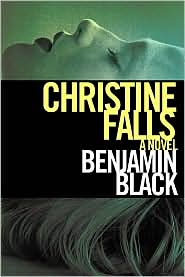
John Banville and Benjamin Black

In an alternate universe, John Banville would be everybody’s teen crush. He’s like the high-school quarterback who gets a starring role in the spring musical. The man can write a Booker-Prize winning novel full of dense, serious prose about deep metaphysical questions, and then pull off two excellent noir novels under the cheeky pseudonym Benjamin Black. Throws the touchdown; aces the finale.

To be fair, neither Christine Falls nor The Silver Swan is exactly a traditional noir or detective novel. Sure, the characters are a bit outsized and vividly drawn; sure there are the noir requisites of dead young women, mysterious parentage, and corruption, lies, and money. There is even, in Christine Falls, a crushing kiss. “When he kissed her he crushed his mouth on hers and tasted blood, whose, hers or his, he was not sure,” Black writes. It’s a scene from a movie: the copper and the broad, then a close-up of the bloody lip.

But though you can take the Banville out of the literary, you can’t take the literary out of the Banville—even when he’s using his other name. In fact, both Black books share Banville’s persistent exploration of the murkiness of identity and history. It’s a twist on the detective tradition of Conan Doyle and Christie (to name just two). Like them, Black is concerned primarily with knowledge. But while Conan Doyle and Christie allow the satisfaction of the slow progress towards knowledge, Black’s books offer no such certainties. With Black, it’s about the impossibility of knowledge. “I don’t know,” Quirke is in the habit of saying.

Then there’s the prose. In his literary novels (the distinction is, quite clearly, less and less workable), Banville writes self-conscious and elegant passages like this one from The Sea, in which his narrator Morden describes his reactions to his wife’s fatal illness:
“My life seemed to be passing before me, not in a flash as it is said to do for those about to drown, but in a sort of leisurely convulsion, emptying itself of its secrets and its quotidian mysteries in preparation for the moment when I must step into the black boat on the shadowed river with the coin of passage cold in my already coldening hand.”

In The Silver Swan, Black doesn’t skimp on the artistry. There is this, to describe Quirke returning to his flat: “there was the usual atmosphere of tight-lipped stealth, as if something vaguely nefarious had been going on that had ceased instantly at the sound of his key in the door.” Or this, in the middle of a dialogue between pathologist and inspector: “Off to their left a herd of deer stood in the long grass amidst a shimmer of heat; a stag lifted its elaborately horned head and eyed them sideways with truculent suspicion.” The novels of Gardner, Hammet and Deighton are full of truculently suspicious people. But I’ll bet not many of them are described that way—or in sentences with semi-colons.

At the end of the day, the experience of reading the Benjamin Black books (The Silver Swan was released in paperback just a month ago) is just what you want from a book. An intelligent mind behind the language and the construction of the narrative, and a plot that makes you eager to read more. As Ron Rosenbaum put it in a recent article in Slate, on Black and two other new detective writers, “It just has to mean that nothing you’re doing (alone anyway) can possibly be as important as getting it done with and getting back to the pages that have you spellbound”. And yet, serious writers still cringe a little when someone calls their books page-turners.

The question arises: is Banville writing as Black better than, say, Raymond Chandler writing as himself? Banville didn’t win any prizes, after all, for the Black novels. (Though his publishers are doing what they can to establish a sort of street cred: the most prominent blurb on the back cover of the Silver Swan paperback features a quotation by none other than Entertainment Weekly.) Of course the real answer is that, Banville’s own professed attempts to imitate Georges Simenon notwithstanding, Black’s books are simply different from a traditional noir novel.

My own view is that, if I had to choose between slightly overcooked high-style sentences combined with noir plots and, on the other hand, the noir plots in the telegraphic, whiskey-shot prose of Chandler, I’d probably take the former. But only if I couldn’t have both. Banville writing as Black seems to me to be, like the intellectual athlete, the perfect combination.

[quotations from Christine Falls, The Sea, and The Silver Swan, copywright Henry Holt and Vintage International]